
75 mg+50 mg+100 mg
Unit Price:
৳ 2,200.00
(1 x 30: ৳ 66,000.00)
Indications
Triko tablet is indicated for the treatment of cystic fibrosis (CF) in patients aged 6 years and older who have at least one F508del mutation in the CFTR gene or a mutation in the CFTR gene that is responsive based on in vitro data.
* রেজিস্টার্ড চিকিৎসকের পরামর্শ মোতাবেক ঔষধ সেবন করুন
Pharmacology
This is a fixed dose combination product containing Ivacaftor, Tezacaftor and Elexacaftor. It is a Cystic Fibrosis Transmembrane Conductance Regulator (CFTR) modulating therapy used to treat Cystic Fibrosis (CF). Ivacaftor potentiates the channel open probability (or gating) of the CFTR protein at the cell surface, where Tezacaftor and Elexacaftor work to improve cellular processing and trafficking, allowing for more CFTR proteins to come to the cell surface. The combined effect increases function of CFTR at the cell surface, resulting in increased CFTR activity.
Dosage & Administration
| Recommended Dosage for Adult and Pediatric Patients Aged 6 Years and Older | |||
| Age | Weight | Morning Dose | Evening Dose |
| 6 to less than 12 years | Less than 30 kg | One tablet, each containing Ivacaftor 75 mg/Tezacaftor 50 mg/ Elexacaftor 100 mg | One tablet of Ivacaftor 75 mg |
| 6 to less than 12 years | 30 kg or more | Two tablets, each containing Ivacaftor 75 mg/Tezacaftor 50 mg/Elexacaftor 100 mg | One tablet of Ivacaftor 150 mg |
| 12 years and older | Two tablets, each containing Ivacaftor 75 mg/Tezacaftor 50 mg/ Elexacaftor 100 mg | One tablet of Ivacaftor 150 mg | |
This tablet should be taken with fat-containing food. Should not be used in patients with severe hepatic impairment. This tablet is not recommended in patients with moderate hepatic impairment unless the benefit exceeds the risk. Reduce dose if used in patients with moderate hepatic impairment. Liver function tests should be closely monitored.
* রেজিস্টার্ড চিকিৎসকের পরামর্শ মোতাবেক ঔষধ সেবন করুন
Interaction
Inducers of CYP3A: Ivacaftor, Tezacaftor and Elexacaftor are substrates of CYP3A. Concomitant use of CYP3A inducers may result in reduced exposures and might reduce the efficacy of this tablet. Co-administration of Ivacaftor with rifampin, a strong CYP3A inducer, significantly decreased Ivacaftor area under the curve (AUC) by 89%. Tezacaftor and Elexacaftor exposures are expected to decrease during co-administration with strong CYP3A inducers. Therefore, co-administration of this tablet with strong CYP3A inducers (eg. rifampin, rifabutin, phenobarbital, carbamazepine, phenytoin and St. John’s wort) is not recommended.
Inhibitors of CYP3A: Co-administration with Itraconazole, a strong CYP3A inhibitor, increased Elexacaftor AUC by 2.8-fold and Tezacaftor AUC by 4.0- to 4.5-fold. When co-administered with Itraconazole and Ketoconazole, Ivacaftor AUC increased by 15.6-fold and 8.5-fold, respectively. The dosage of this tablet should be reduced when co-administered with strong CYP3A inhibitors (Ketoconazole, Itraconazole, Posaconazole, Voriconazole, Telithromycin and Clarithromycin) and moderate CYP3A inhibitors (Fluconazole, Erythromycin). Food or drink containing grapefruit should be avoided during treatment with this tablet.
CYP2C9 Substrates: Ivacaftor may inhibit CYP2C9; therefore, monitoring of the international normalized ratio (INR) during co-administration of this tablet with warfarin is recommended. Other medicinal products for which exposure may be increased by this tablet include glimepiride and glipizide; these medicinal products should be used with caution.
Transporters: Co-administration of Ivacaftor or Ivacaftor/Tezacaftor with digoxin, a sensitive P-gp substrate, increased digoxin AUC by 1.3-fold, consistent with weak inhibition of P-gp by ivacaftor. Administration of this tablet may increase systemic exposure of medicinal products that are sensitive substrates of P-gp, which may increase or prolong their therapeutic effect and adverse reactions. When used concomitantly with digoxin or other substrates of P-gp with a narrow therapeutic index such as cyclosporine, everolimus, sirolimus and tacrolimus, caution and appropriate monitoring should be used.
Inhibitors of CYP3A: Co-administration with Itraconazole, a strong CYP3A inhibitor, increased Elexacaftor AUC by 2.8-fold and Tezacaftor AUC by 4.0- to 4.5-fold. When co-administered with Itraconazole and Ketoconazole, Ivacaftor AUC increased by 15.6-fold and 8.5-fold, respectively. The dosage of this tablet should be reduced when co-administered with strong CYP3A inhibitors (Ketoconazole, Itraconazole, Posaconazole, Voriconazole, Telithromycin and Clarithromycin) and moderate CYP3A inhibitors (Fluconazole, Erythromycin). Food or drink containing grapefruit should be avoided during treatment with this tablet.
CYP2C9 Substrates: Ivacaftor may inhibit CYP2C9; therefore, monitoring of the international normalized ratio (INR) during co-administration of this tablet with warfarin is recommended. Other medicinal products for which exposure may be increased by this tablet include glimepiride and glipizide; these medicinal products should be used with caution.
Transporters: Co-administration of Ivacaftor or Ivacaftor/Tezacaftor with digoxin, a sensitive P-gp substrate, increased digoxin AUC by 1.3-fold, consistent with weak inhibition of P-gp by ivacaftor. Administration of this tablet may increase systemic exposure of medicinal products that are sensitive substrates of P-gp, which may increase or prolong their therapeutic effect and adverse reactions. When used concomitantly with digoxin or other substrates of P-gp with a narrow therapeutic index such as cyclosporine, everolimus, sirolimus and tacrolimus, caution and appropriate monitoring should be used.
Side Effects
- Elevated Transaminases and Hepatic Injury.
- Cataracts in pediatric patients have been reported.
Pregnancy & Lactation
Pregnancy: There are limited and incomplete human data from clinical trials on the use of Ivacaftor, Tezacaftor and Elexacaftor or its individual components, in pregnant women to inform a drug-associated risk.
Lactation: Ivacaftor, Tezacaftor and Elexacaftor are excreted into the milk of lactating rats. The developmental and health benefits of breastfeeding should be considered along with the mother’s clinical need for this tablet and any potential adverse effects on the breastfed child from Triko® or from the underlying maternal condition.
Lactation: Ivacaftor, Tezacaftor and Elexacaftor are excreted into the milk of lactating rats. The developmental and health benefits of breastfeeding should be considered along with the mother’s clinical need for this tablet and any potential adverse effects on the breastfed child from Triko® or from the underlying maternal condition.
Precautions & Warnings
Elevated Transaminases and Hepatic Injury: Liver failure leading to transplantation has been reported in a patient with cirrhosis and portal hypertension while receiving Ivacaftor, Tezacaftor and Elexacaftor combination. Avoid use of This tablet in patients with pre-existing advanced liver disease (e.g., as evidenced by cirrhosis, portal hypertension, ascites, hepatic encephalopathy) unless the benefits are expected to outweigh the risks. If used in these patients, they should be closely monitored after the initiation of treatment. Isolated elevations of transaminases or bilirubin have been observed in patients with CF. In some instances, transaminase elevations have been associated with concomitant elevations in total bilirubin and/or international normalized ratio (INR) and have resulted in patients being hospitalized for intervention, including in patients without a history of pre-existing liver disease.
Concomitant Use with CYP3A Inducers: Exposure to Ivacaftor is significantly decreased and exposure to Tezacaftor and Elexacaftor are expected to decrease by the concomitant use of strong CYP3A inducers, which may reduce the therapeutic effectiveness of this tablet. Therefore, co-administration with strong CYP3A inducers is not recommended.
Concomitant Use with CYP3A Inhibitors: Exposure to Ivacaftor, Tezacaftor and Elexacaftor are increased when co-administered with strong or moderate CYP3A inhibitors. Therefore, the dose of this tablet should be reduced when used concomitantly with moderate or strong CYP3A inhibitors.
Cataracts: Cases of non-congenital lens opacities have been reported in pediatric patients treated with ivacaftor-containing regimens. Although other risk factors were present in some cases (such as corticosteroid use, exposure to radiation), a possible risk attributable to treatment with Ivacaftor cannot be excluded. Baseline and follow-up ophthalmological examinations are recommended in pediatric patients initiating treatment with this tablet.
Concomitant Use with CYP3A Inducers: Exposure to Ivacaftor is significantly decreased and exposure to Tezacaftor and Elexacaftor are expected to decrease by the concomitant use of strong CYP3A inducers, which may reduce the therapeutic effectiveness of this tablet. Therefore, co-administration with strong CYP3A inducers is not recommended.
Concomitant Use with CYP3A Inhibitors: Exposure to Ivacaftor, Tezacaftor and Elexacaftor are increased when co-administered with strong or moderate CYP3A inhibitors. Therefore, the dose of this tablet should be reduced when used concomitantly with moderate or strong CYP3A inhibitors.
Cataracts: Cases of non-congenital lens opacities have been reported in pediatric patients treated with ivacaftor-containing regimens. Although other risk factors were present in some cases (such as corticosteroid use, exposure to radiation), a possible risk attributable to treatment with Ivacaftor cannot be excluded. Baseline and follow-up ophthalmological examinations are recommended in pediatric patients initiating treatment with this tablet.
Use in Special Populations
Pediatric Use: The safety and effectiveness of this tablet for the treatment of CF have been established in pediatric patients aged 2 years to less than 18 years who have at least one F508del mutation in the CFTR gene or a mutation in the CFTR gene that is responsive based on in vitro data.
Geriatric Use: Clinical studies of this tablet did not include any patients aged 65 years and older.
Hepatic Impairment:
Geriatric Use: Clinical studies of this tablet did not include any patients aged 65 years and older.
Hepatic Impairment:
- Mild Hepatic Impairment (Child-Pugh Class A): No dose modification is recommended. Liver function tests should be closely monitored.
- Moderate Hepatic Impairment (Child-Pugh Class B): Treatment is not recommended. Use of this tablet in patients with moderate hepatic impairment should only be considered when there is a clear medical need, and the benefit exceeds the risk. If used in patients with moderate hepatic impairment, this tablet should be used at a reduced dose.
- Severe Hepatic Impairment (Child-Pugh Class C): Should not be used. this tablet has not been studied in patients with severe hepatic impairment (Child-Pugh Class C), but the exposure is expected to be higher than in patients with moderate hepatic impairment.
Overdose Effects
No specific antidote is available for overdosage with this tablet. Treatment of overdosage consists of general supportive measures including monitoring of vital signs and observation of the clinical status of the patient.
Therapeutic Class
Cystic Fibrosis Transmembrane Conductance Regulator (CFTR)
Storage Conditions
Do not store above 30°C. Keep in a dry place. Protect from light and keep out of the reach of children.
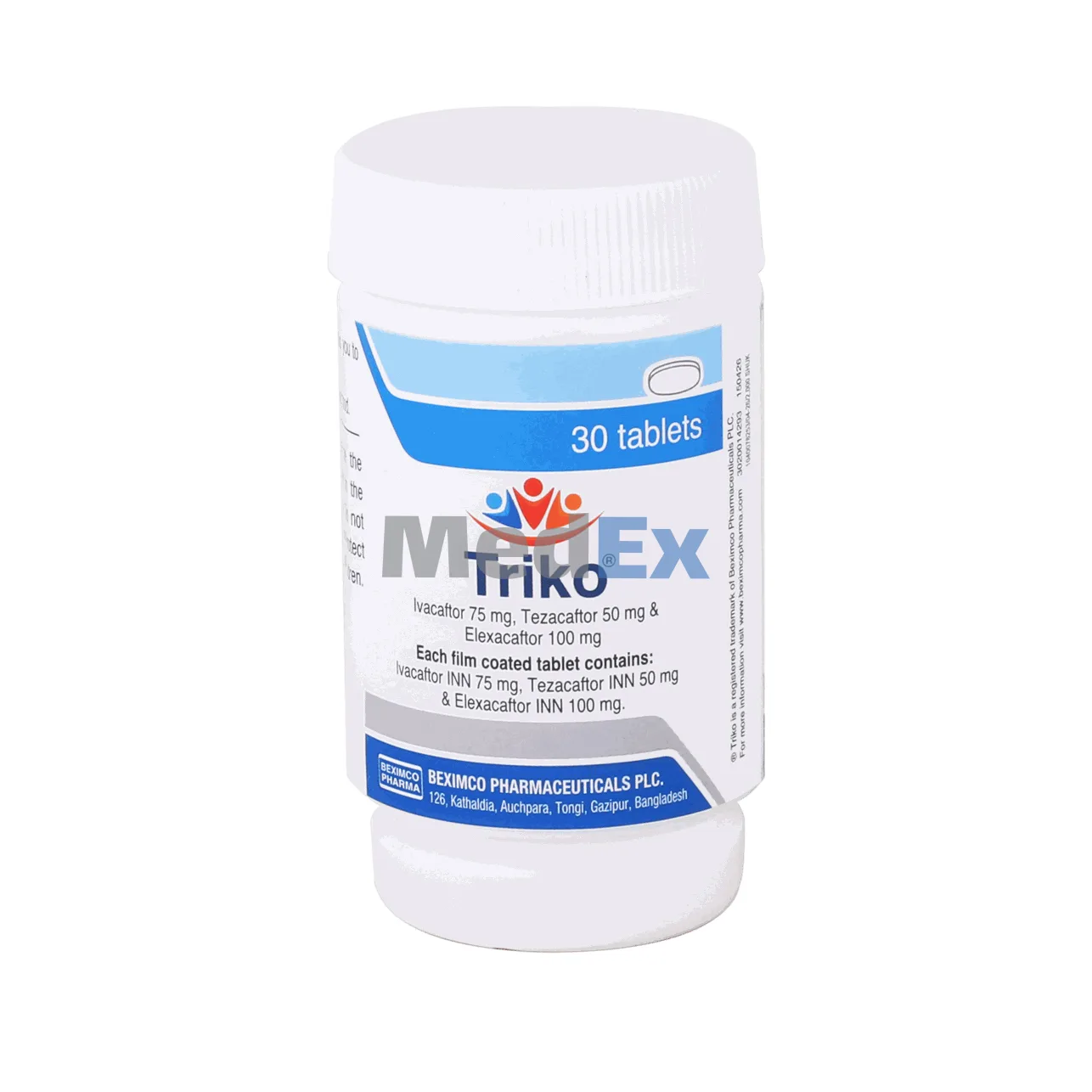 Pack Image: Triko 75 mg+50 mg+100 mg Tablet