
Unit Price:
৳ 775.00
(1 x 30: ৳ 23,250.00)
Indications
Bexdeco is a cystic fibrosis transmembrane conductance regulator (CFTR) potentiator indicated for the treatment of cystic fibrosis (CF) in patients age 6 years and older who have at least one mutation in the CFTR gene that is responsive to Bexdeco based on clinical and/or in vitro assay data.
* রেজিস্টার্ড চিকিৎসকের পরামর্শ মোতাবেক ঔষধ সেবন করুন
Pharmacology
Ivacaftor is a first-in-class CFTR potentiator, it works by prolonging the time that activated CFTR channels remain open, thereby enhancing the regulation of chloride and water transport across cell membranes. This results in improved functioning of multiple organs, most notably lungs.
Dosage & Administration
6 years and older: One 150 mg tablet every 12 hours. Taken orally with fat containing food.
Ivacaftor is not recommended in patients less than 6 years of age with any level of hepatic impairment. No dose adjustment is necessary for patients aged 6 months and older with hepatic impairment. Administer Ivacaftor tablets with fat-containing food. Examples include eggs, butter, peanut butter, cheese pizza, whole-milk dairy products (such as whole milk, cheese, yogurt, breast milk, or infant formula), etc.
Ivacaftor is not recommended in patients less than 6 years of age with any level of hepatic impairment. No dose adjustment is necessary for patients aged 6 months and older with hepatic impairment. Administer Ivacaftor tablets with fat-containing food. Examples include eggs, butter, peanut butter, cheese pizza, whole-milk dairy products (such as whole milk, cheese, yogurt, breast milk, or infant formula), etc.
* রেজিস্টার্ড চিকিৎসকের পরামর্শ মোতাবেক ঔষধ সেবন করুন
Interaction
Inhibitors of CYP3A: Bexdeco is a sensitive CYP3A substrate. Co-administration with ketoconazole, a strong CYP3A inhibitor, significantly increased Bexdeco exposure by 8.5 fold. Based on simulations of these results, a reduction of the Bexdeco dose is recommended for patients 6 years and older taking concomitant strong CYP3A inhibitors, such as ketoconazole, itraconazole, posaconazole, voriconazole, telithromycin, and clarithromycin.
Inducers of CYP3A: Co-administration with rifampin, a strong CYP3A inducer,significantly decreased Bexdeco exposure (AUC) by approximately 9-fold. Therefore, co-administration with strong CYP3A inducers, such as rifampin, rifabutin, phenobarbital, carbamazepine, phenytoin, and St. John’s wort is not recommended.
CYP2C9 Substrates: Bexdeco may inhibit CYP2C9; therefore, monitoring of the international normalized ratio (INR) during co-administration of Bexdeco with warfarin is recommended.
CYP3A and/or P-gp Substrates: Bexdeco and its M1 metabolite have the potential to inhibit CYP3A and P-gp. Co-administration with oral midazolam, a sensitive CYP3A substrate, increased midazolam exposure 1.5 fold, consistent with weak inhibition of CYP3A by Bexdeco. Co-administration with digoxin, a sensitive P-gp substrate, increased digoxin exposure by 1.3 fold, consistent with weak inhibition of P-gp by Bexdeco. Administration of Bexdeco may increase systemic exposure of drugs that are substrates of CYP3A and/or P-gp, which may increase or prolong their therapeutic effect and adverse events. Therefore, caution and appropriate monitoring are recommended when co-administering Bexdeco with sensitive CYP3A and/or P-gp substrates, such as digoxin, cyclosporine, and tacrolimus.
Inducers of CYP3A: Co-administration with rifampin, a strong CYP3A inducer,significantly decreased Bexdeco exposure (AUC) by approximately 9-fold. Therefore, co-administration with strong CYP3A inducers, such as rifampin, rifabutin, phenobarbital, carbamazepine, phenytoin, and St. John’s wort is not recommended.
CYP2C9 Substrates: Bexdeco may inhibit CYP2C9; therefore, monitoring of the international normalized ratio (INR) during co-administration of Bexdeco with warfarin is recommended.
CYP3A and/or P-gp Substrates: Bexdeco and its M1 metabolite have the potential to inhibit CYP3A and P-gp. Co-administration with oral midazolam, a sensitive CYP3A substrate, increased midazolam exposure 1.5 fold, consistent with weak inhibition of CYP3A by Bexdeco. Co-administration with digoxin, a sensitive P-gp substrate, increased digoxin exposure by 1.3 fold, consistent with weak inhibition of P-gp by Bexdeco. Administration of Bexdeco may increase systemic exposure of drugs that are substrates of CYP3A and/or P-gp, which may increase or prolong their therapeutic effect and adverse events. Therefore, caution and appropriate monitoring are recommended when co-administering Bexdeco with sensitive CYP3A and/or P-gp substrates, such as digoxin, cyclosporine, and tacrolimus.
Side Effects
- Elevated transaminases have been reported in patients with CF receiving Bexdeco.
- Cataracts in pediatric patients have been reported.
Pregnancy & Lactation
Pregnancy: There are limited and incomplete human data from clinical trials and post-marketing reports on use of Ivacaftor in pregnant women.
Lactation: There is no information regarding the presence of Ivacaftor in human milk, the effects on the breastfed infant, or the effects on milk production. The developmental and health benefits of breastfeeding should be considered along with the mother’s clinical need for Ivacaftor.
Lactation: There is no information regarding the presence of Ivacaftor in human milk, the effects on the breastfed infant, or the effects on milk production. The developmental and health benefits of breastfeeding should be considered along with the mother’s clinical need for Ivacaftor.
Precautions & Warnings
Transaminase (ALT or AST) Elevations: Elevated transaminases have been reported in patients with CF receiving Bexdeco. ALT and AST should be assessed prior to initiating Bexdeco, every 3 months during the first year of treatment, and annually thereafter. For patients with a history of transaminase elevations, consider more frequent monitoring of liver function tests. Patients who develop increased transaminase levels should be closely monitored until the abnormalities are resolved. Dosing should be interrupted in patients with ALT or AST of greater than 5 times the upper limit of normal (ULN). Following resolution of transaminase elevations, consider the benefits and risks of resuming Bexdeco.
Concomitant Use with CYP3A Inducers: Use of Bexdeco with strong CYP3A inducers, such as rifampin, substantially decreases the exposure of Bexdeco, which may reduce the therapeutic effectiveness of Bexdeco. Therefore, co-administration of Bexdeco with strong CYP3A inducers is not.
Cataracts: Cases of non-congenital lens opacities/cataracts have been reported in pediatric patients treated with Bexdeco. Although other risk factors were present in some cases (such as corticosteroid use and/or exposure to radiation), a possible risk attributable to Bexdeco cannot be excluded. Baseline and follow-up ophthalmological examinations are recommended in pediatric patients initiating Bexdeco treatment.
Concomitant Use with CYP3A Inducers: Use of Bexdeco with strong CYP3A inducers, such as rifampin, substantially decreases the exposure of Bexdeco, which may reduce the therapeutic effectiveness of Bexdeco. Therefore, co-administration of Bexdeco with strong CYP3A inducers is not.
Cataracts: Cases of non-congenital lens opacities/cataracts have been reported in pediatric patients treated with Bexdeco. Although other risk factors were present in some cases (such as corticosteroid use and/or exposure to radiation), a possible risk attributable to Bexdeco cannot be excluded. Baseline and follow-up ophthalmological examinations are recommended in pediatric patients initiating Bexdeco treatment.
Use in Special Populations
Pediatric Use:The safety and effectiveness of Bexdeco for the treatment of CF have been established in pediatric patients 2 years to 17 years of age who have at least one mutation in the CFTR gene that is responsive to Bexdeco potentiation based on clinical and/or in vitro assay data.
Geriatric Use: CF is largely a disease of children and young adults. Clinical trials of Bexdeco did not include sufficient numbers of patients 65 years of age and over to determine whether they respond differently from younger patients.
Hepatic Impairment:
Geriatric Use: CF is largely a disease of children and young adults. Clinical trials of Bexdeco did not include sufficient numbers of patients 65 years of age and over to determine whether they respond differently from younger patients.
Hepatic Impairment:
- Mild Hepatic Impairment (Child-Pugh Class A): No dose adjustment is necessary for patients aged 2 years or older.
- Moderate Hepatic Impairment (Child-Pugh Class B): A reduced dose is recommended in patients aged 2 years or older.
- Severe Hepatic Impairment (Child-Pugh Class C): Use with caution at a reduced dose, in patients aged 2 years or older with severe hepatic impairment after weighing the risks and benefits of treatment.
Therapeutic Class
Cystic Fibrosis Transmembrane Conductance Regulator (CFTR)
Storage Conditions
Do not store above 30°C. Keep in a dry place. Protect from light and keep out of the reach of children.
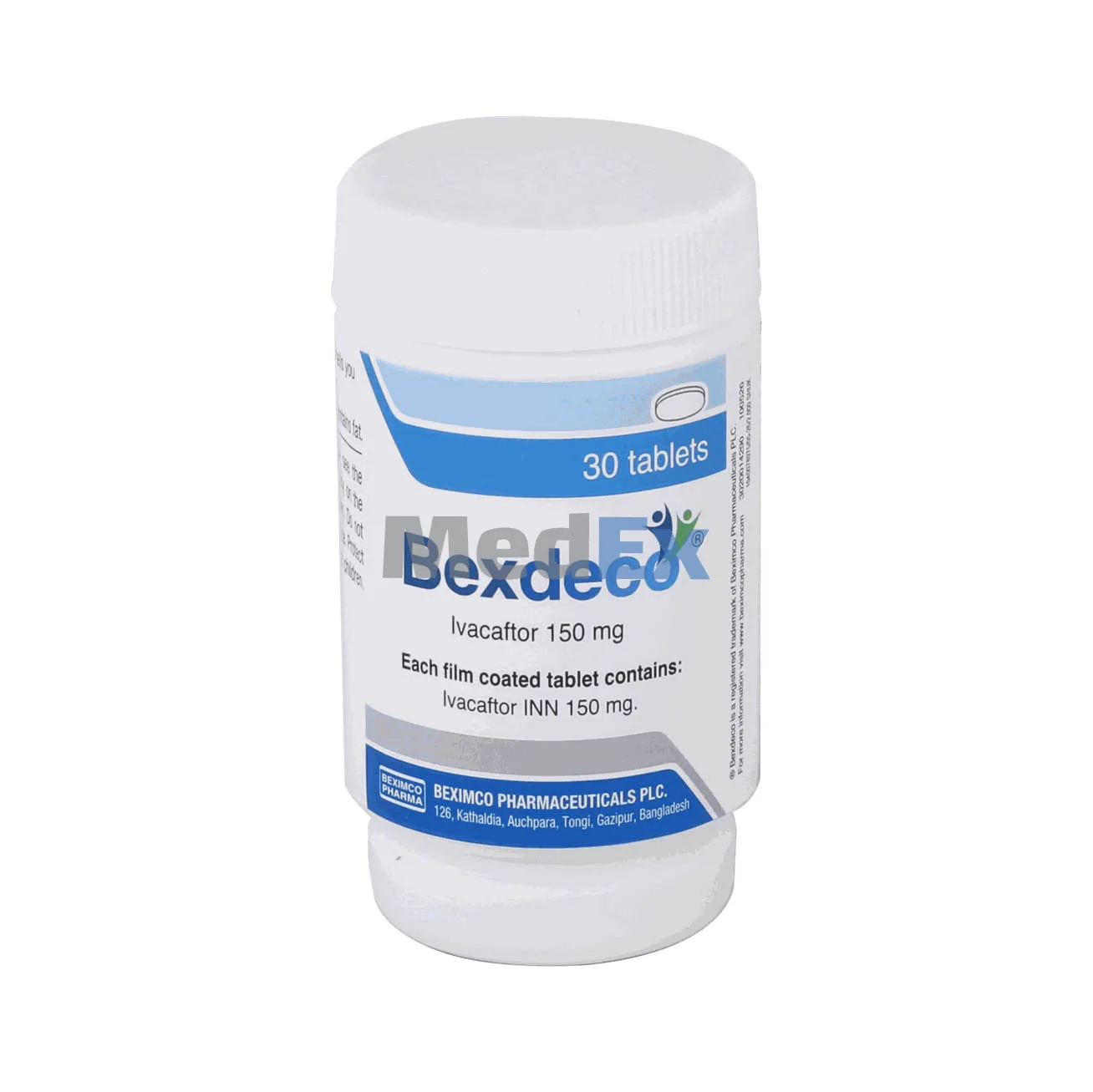 Pack Image: Bexdeco 150 mg Tablet